
Many companies are thinking about how they can take advantage of social-networking technology, but analysts at Gartner are warning against getting caught up in the hype.
Businesses are advised to consider certain issues before investing in or developing internal social-networking tools. These include protecting personal intellectual property, as well as people's preference for using existing nonprofessional, external networks such as Bebo, Facebook and MySpace.com.
With Facebook saying it will license its developer platform to other organizations, it also could become even easier for companies to develop their own social networks.
But the Gartner report says the hype around social networking doesn't necessarily mean it's a mature enough technology to make it a critical business requirement.
There is also little evidence that social networking will be as beneficial for businesses as other Web-based communications technology, such as instant messaging.
Ultimately, Gartner suggests, the value of social-networking technology comes from content rather than the product itself. The analysts recommend that IT departments think very carefully before committing to expensive "social-networking white elephants."
Earlier this month, business networking site LinkedIn also said it will let third parties develop applications for its site and take LinkedIn content to other sites.
Tim Ferguson of Silicon.com reported from London
Monday, December 17, 2007
Companies Warned Not to Rush Into Social Networking

Sunday, December 16, 2007
Social Network - what is it?
For social networks to work online they must function the same way that social networks do offline. If you look at your own social network of friends and family, there are three basic requirements:
1. A real identity
Each of us has an identity that is easily recognized by our social contacts. This isn’t just our name and our ‘look’. It’s also what we do, where we live, what we think, and so on.
A lot of this is background information that we store in our heads or in some note form.
We continuously update our list of facts our contacts. As lives change, for example, addresses and phone numbers, friends, etc. we update our knowledge about them.
2. Easy communication
In real life social networks there is an easy-going form of communication.
We ‘open-up’ to different degrees to various people, and they to us.
We like to talk about ourselves, about other people, and about things that happen to us.
The conversations we have can be thought of as ‘micro-socializing’ – short sentences, glances, gestures, are all forms of short messages.
3. Easy filtering
In our social circles, there is an automatic filtering mechanism that works. We have an understanding among friends and acquaintances that says what can and can’t be revealed about other people.
Online social networks need to provide the same functionality to deliver value to their users. It is this functionality that makes it work. Paul Buchheit has summarised what good online social networks are able to do.
There's no such thing as a "social network"
Paul Buchheit
Of course there are many things that people call "social networks", but that's more confusing than enlightening. The "social network" aspect of these products is just a mechanism, not the purpose, and their purposes are often more different than similar. It's like saying that something is a "Javascript". Many websites use Javascript, but hopefully the Javascript is only there in order to accomplish some other purpose. LinkedIn and Twitter, for example, both use Javascript and social networking mechanisms, but clearly they are very different products and have very different uses. Facebook likes to call itself a "social utility", but to me that's just as meaningless.
That said, there is something "social networky" that unites these otherwise-dissimilar "social networking" sites. The two features that seem to define the social network aspect of a product are:
- Some kind of page or profile for each user. The contents of this page vary wildly, but it always includes a name and often a picture.
- "Friend" links among the profile pages, which may or may not be bi-directional. These "friends" only sometimes correspond to real-life friends.
So what ARE the purposes of these many "social networking" products? (in random order)
- Enable people to send messages to their friends. This functionality basically defines email, which can be considered one of the earliest "social networks", though most email systems lack browsable profiles. Annoyingly, many other social networking products reimplement this function, with mixed results.
- Enable people to send messages to non-friends. There are two aspects to this feature: discovery (finding the people) and control (preventing unwanted messages). Email is weak on both aspects, and for many people, this is one of the most useful features of products such as Facebook and LinkedIn (I can easily find and contact people that I don't know).
- "Live" address/phone book. Sites like Facebook have fields for phone, email, etc, and since everyone maintains their own page, the information is generally up-to-date (vs the bad-old-world of everyone having to broadcast "please update your address books" every time they move).
- Less private communication. Email and IM are often too private. Life would be much less interesting if all of our conversations took place one-on-one in closed rooms. Part of what makes parties, offices, and other social environments interesting is that we can observe other people interacting, overhear conversations, and often join-in. Features such as the "wall" create a kind of public or semi-public email, allowing our friends to overhear conversations. Twitter is often used as a public IM/chat.
- Passive communication about my life. I don't want to interrupt or spam my friends every time I have some little bit of news, take some new pictures, or get a random thought, but I have no problem blogging or Twittering those things, or uploading to photo sharing sites (which all have social features now). Similarly, I enjoy seeing this information from my friends (but I wouldn't want them calling me on the phone to tell me about their lunch every day).
- Passive sharing of non-personal content. I'll occasionally see an interesting or amusing web page and want to share it with friends. I used to put these things into my IM status, but now I add them to my FriendFeed. Email, Twitter, Facebook, and Digg/Reddit are also sometimes used for this purpose (though obviously Digg is less "friend" oriented).
- Self expression. This is most prominent on MySpace, where user profiles are highly customizable and can have embedded music (which starts playing as soon as I visit the page). This behavior is very similar to decorating your house or bedroom in "real life" -- there seems to be some human instinct to define our identity through decorations, fashion, music, art, etc. Self expression is an element of all products which have browsable profiles, but on most sites identity is expressed more in terms of content (favorite movies on Facebook, job history on LinkedIn, tweets on Twitter, etc).
- Background information. If I meet someone new (or am about to meet them), I sometimes checkout their Facebook or LinkedIn pages to learn more about their background, see if we have common friends, etc. Obviously this also ties in with self-expression and identity in more social settings -- people "friend" each other after meeting and their MySpace page (or whatever) becomes part of that "first" impression.
- Dating. One of the earliest and still most popular uses of sites like MySpace, Facebook, Orkut, etc. It's less "explicit" than on dating sites, but by putting themselves online, people can see and be seen, plus get background info, see who their common friends are, etc. The Facebook newsfeed even tells us when friends break-up (or start dating).
- Jobs. Job hunting and hiring are essentially the "professional" analog of dating and seem to work in somewhat similar ways.
- Finding old friends. By enabling friend-of-friend and school class browsing, it's much easier to locate old friends, and therefore people do more of it. This also lets people track down old friends without appearing crazy (they can "bump" into them on classmates.com, or whatever -- no private detective needed).
- Keeping in touch with "unclose" friends (related to "passive communication about my life"). It's fun to know what's going on with people who we've known in the past, even if we aren't close friends. Profile browsing and newsfeeds make this easier. This can also make unclose friends into closer friends, as we may coincidentally be in the same city at the same time, be attending the same events, or just start chatting.
- "Micro-socializing" (I need a better term here). A lot of wall posts, poking, winking, commenting, Twittering, etc can go into the category. The comments on FriendFeed generally fall into this category as well -- someone shares a link or posts some photos, then they and their friends will end up chatting about it. This is somewhat analogous to the traditional "water-cooler" conversation.
- Word-of-mouth recommendations. Shared links, news, Yelp reviews, some Twitters, and the like provide us with information about what our friends are doing. Word-of-mouth can be very powerful since we typically trust our friends much more than random people. The new Facebook "Beacon" advertising system is trying to use this effect to sell things.
- General amusement for bored people. Clicking around on friends and friends-of-friends and even random people's pages can be kind of interesting. As sites provide more content (such as the links and videos on FriendFeed) or games (many popular Facebook apps are games) there will be even more of this.
- Publishing. This especially applies to blogs, twitter, flickr, and the like, but being able to subscribe to the content produced by our favorite authors and artists as well as friends and family is very powerful for both the producer and the consumer.
- Group sharing and socializing. This was traditionally done via mailing lists and that's the model behind Google/Yahoo Groups, but of course Facebook, Orkut and the like have have some basic group functionality too, and Ning seems to specialize in it by enabling each group to create their own social network.
Saturday, December 15, 2007
Social Network Advertising's Promise
How much can social networks net?
Social networking is an Internet success story.
This year, 37% of the US adult Internet population used online social networking at least once a month. That figure will rise to 49% in 2011.
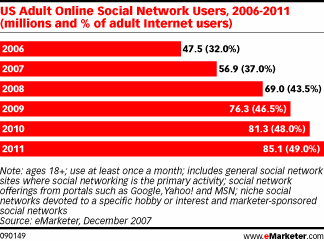
"The continued growth of social networking seems assured," says Debra Aho Williamson, eMarketer Senior Analyst and author of the new report "Social Network Marketing: Ad Spending and Usage", "unless teens stop social networking as they become adults."
Don’t bet on that.
Currently, 70% of all US teens visit social network sites on a monthly basis.

"By 2011, one-half of all online adults and 84% of online teens in the US will use social networking each month," says Ms. Williamson. "There is little to suggest that this activity will go away."
When it comes to translating eyeballs into advertising revenues, eMarketer projects that worldwide online social network ad spending will grow from $1.2 billion in 2007 to $2.2 billion in 2008, 82%.
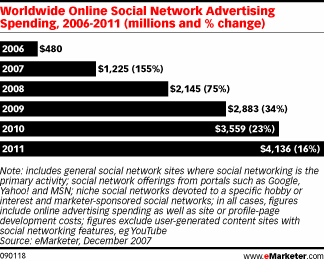
In the US, spending is projected to rise to $1.6 million in 2008, from $920 million in 2007.
"MySpace and Facebook together receive more than 70% of all US social network ad spending," says Ms. Williamson. "And they are hard at work to convince marketers to allot more of their budgets to social network advertising."
The advertising offerings of the two social network giants are becoming more diversified, and now include not only profile pages but search, display ads, widgets and more.
"But if social network marketing delivers on its promise of peer recommendations the flow of advertising dollars will turn into a flood," says Ms. Williamson.
eMarketer.com